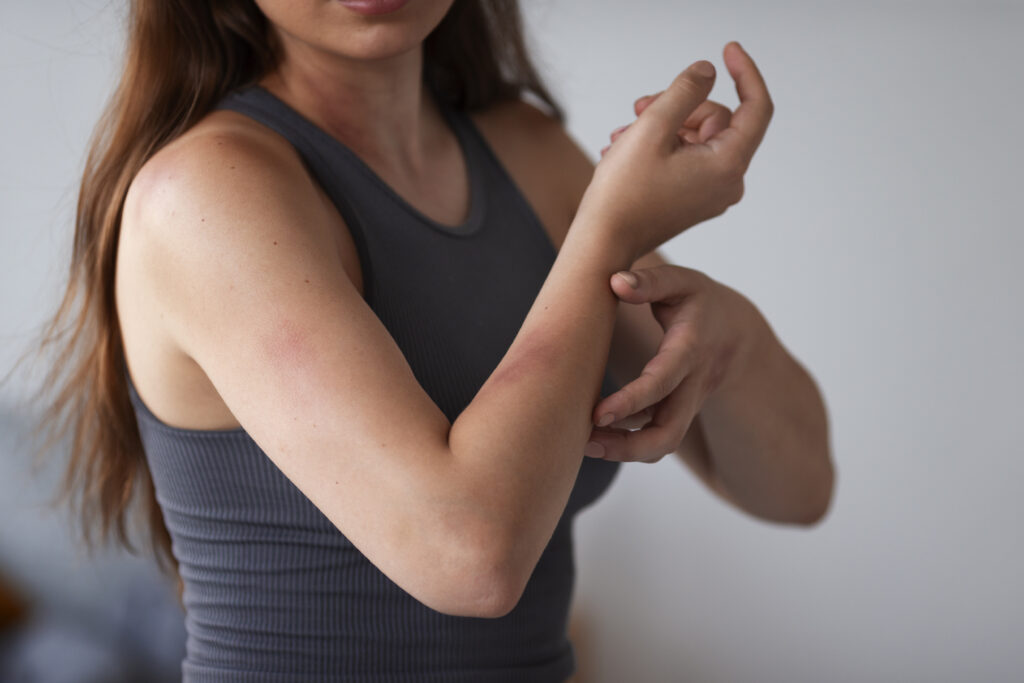
Novomed clinics offer psoriasis treatment in Dubai, providing personalized dermatological care to help manage this chronic skin condition. Our dermatology team assesses the type, severity, and affected areas to recommend suitable treatment options. Treatment may include topical medications, phototherapy, or systemic therapies, depending on individual needs.
What is Psoriasis?
Psoriasis is an autoimmune disorder that occurs due to skin cells multiplying up to 10 times faster than normal. When the underlying cells reach the skin’s surface and die, they start to build up. The accumulation of dead cells on the skin’s surface appears as raised, red patches covered with white or silvery scales.
Triggers for psoriasis include:
- Cuts, scrapes, stings and sunburn
- Infections, for example strep throat or skin infections
- Lifestyle factors such as stress, smoking, heavy alcohol consumption
- Vitamin D deficiency
- Certain medications including antimalarial drugs, iodides, beta blockers, etc
While it can be found anywhere on the body, psoriasis normally occurs on the scalp, knees, soles of the feet, elbows, palms and torso. There is no cure for psoriasis, but it typically responds well to topical and systemic treatments, as well as light therapy. These can improve your symptoms and help you control it better.
Symptoms of Psoriasis
Common signs and symptoms of psoriasis include:
- Red patches of skin covered with thick, silvery scales
- Small scaling spots (commonly seen in children)
- Dry, cracked skin that may bleed
- Itching, burning or soreness
- Thickened, pitted or ridged nails
- Swollen and stiff joints
types of psoriasis
These symptoms, though, will vary from person to person, and also in accordance with the type of psoriasis you have:
- Erythrodermic psoriasis: While rare, this form of psoriasis can cover your entire body with a red, peeling, itchy or burning rash.
- Guttate psoriasis: The lesions in the guttate form are in the shape of drops (gutta, is Latin for ‘drop’), and they are covered by a fine scale. Affecting mainly adolescents and children, guttate psoriasis is often triggered by a bacterial infection, for example, strep throat.
- Inverse psoriasis: In this form, the patches of red, inflamed skin are smooth, not scaly as in other forms. Inverse psoriasis may result from a fungal infection and it typically affects skin on the groin, armpits, under the breasts and around the genitals.
- Nail psoriasis: As the name implies, this form affects fingernails and toenails, causing abnormal growth, with ridges or pitting, and discoloration. Psoriatic nails might loosen and separate from the nail bed or, in severe cases, the nail may crumble.
- Plaque psoriasis: This is the most common form of psoriasis and can occur anywhere on the body, including the soft tissue inside your mouth. It is marked by raised, dry, red, itchy or painful skin lesions covered by silvery scales.
- Psoriatic arthritis: In addition to characteristics of psoriasis such as scaly and inflamed skin, sufferers of this form also experience painful, swollen joints typical of arthritis. Usually the lesions appear first, but sometimes the arthritis comes first.
- Pustular psoriasis: This uncommon form is characterized by pus-filled blisters and can occur over large areas, or just smaller areas such as your fingertips. The blisters may disappear and reappear frequently. Other symptoms are chills, fever, itching and diarrhea.
When to see a Dermatologist
No matter the severity of your psoriasis, you should seek out a dermatologist. Even though there is no cure for psoriasis, you don’t have to live with the discomfort as a dermatologist can help you manage it.
Psoriasis Diagnosis
Usually, psoriasis can be diagnosed without any tests, simply by taking your medical history and analyzing your skin, hair or nails. There are three main forms of treatment – topical ointments, light therapy (phototherapy, UVA and UBV) and medication (oral or injections). Conventionally, we start with the most conservative options (ointments and light therapy) and then move on to medication if necessary.
Psoriasis Treatment Options
Psoriasis treatment depends on the severity, type, and extent of the condition. Common treatment options include:
- Topical Treatments: Medicated creams, ointments, and lotions that help reduce inflammation, scaling, and itching.
- Phototherapy (Light Therapy): Controlled exposure to ultraviolet (UV) light to slow excessive skin cell growth.
- Oral Medications: Prescription medications that help manage moderate to severe psoriasis by reducing inflammation and regulating the immune system.
- Biologic Therapies: Advanced injectable or infusion treatments that target specific parts of the immune system involved in psoriasis.
- Lifestyle Management: Regular moisturizing, stress reduction, avoiding triggers, and maintaining a healthy lifestyle can help minimize flare-ups.
A dermatologist can recommend the most suitable treatment plan based on your symptoms and medical history.
Psoriasis Treatment Steps
Psoriasis treatment at Novomed in Dubai begins with a dermatological assessment to determine the type, severity, and affected areas of the condition. The treatment plan is personalized according to each patient’s needs.
|
Step |
Procedure |
Estimated Time |
|---|---|---|
|
1. Dermatological Consultation |
Review of medical history, symptoms, flare-up patterns, and family history. |
15–30 minutes |
|
2. Skin Examination and Diagnosis |
Examination of affected areas to assess psoriasis severity and distinguish it from other skin conditions. A skin biopsy may be recommended if needed. |
10–20 minutes |
|
3. Personalized Treatment Plan |
Selection of suitable treatments, such as topical medications, phototherapy, or systemic therapies, based on individual needs. |
10–15 minutes |
|
4. Treatment Sessions |
Administration or prescription of the selected treatment. Phototherapy may require multiple sessions over several weeks. |
15–60 minutes |
|
5. Follow-Up Assessment |
Evaluation of treatment response, symptom improvement, and potential side effects. |
15–20 minutes |
|
6. Ongoing Skin Management |
Guidance on skin care, flare-up management, and maintenance treatment to help control symptoms. |
As recommended |
Treatment duration and frequency vary depending on psoriasis type, severity, treatment method, and individual response.
How much does psoriasis treatment cost in Dubai?
The cost of psoriasis treatment in Dubai typically ranges from AED 300 to AED 5,000+, depending on the severity of the condition and the treatment required.
Common costs include:
- Dermatology consultation: AED 300–800
- Topical medications: Additional cost depending on the prescription
- Phototherapy (light therapy): AED 300–1,000 per session
- Oral medications: Varies based on the medication prescribed
- Biologic therapies: AED 2,000–5,000+ per treatment cycle, depending on the specific medication
The exact cost depends on the type of psoriasis, treatment plan, number of sessions required, and whether advanced therapies are needed. Most patients benefit from a personalized treatment approach developed by a dermatologist.
Why Choose Novomed for Psoriasis Treatment?
-
Specialist dermatology care: Assessment by dermatology professionals experienced in managing skin conditions.
-
Personalized treatment plans: Recommendations based on psoriasis type, severity, affected areas, and individual needs.
-
Treatment options: Care may include topical medications, phototherapy, or systemic treatments when appropriate.
-
Ongoing follow-up: Monitoring treatment response and adjusting the plan as needed.
-
Patient-focused approach: Guidance on skin care and managing flare-ups as part of long-term care.
Schedule your appointment at Novomed today!
To book a consultation with one of our expert dermatologists in Dubai, call us at 8006686, fill out the booking form or click the live chat icon at the bottom of the screen.
Novomed Dubai Branches
| Branch | Location |
|---|---|
| Novomed Marina | Marina Plaza, 30th Floor, Dubai Marina |
| Novomed Jumeirah 1 | Villa 41, Street 10C, behind Jumeirah Plaza |
| Novomed Aesthetica | Villa 805, Jumeirah Beach Road, Umm Suqeim 3 |
| Novomed Wellness | Villa 68, 17C Street, Umm Suqeim 3 |
| Novomed Surgical Hospital | 26th Street, opposite King’s School, Al Wasl Road |
| Novomed by Dr. Hala | Villa 5B, corner of 5B Street and Jumeirah Beach Road, Jumeirah 1 |
| Novomed Mirdif | Mirdif Hills Avenue, 34A 78th Street, Mirdif |